Night Sky · Cleveland, Ohio
Photographing the August 2026 Lunar Eclipse Over Northeast Ohio
AUGUST 28, 2026
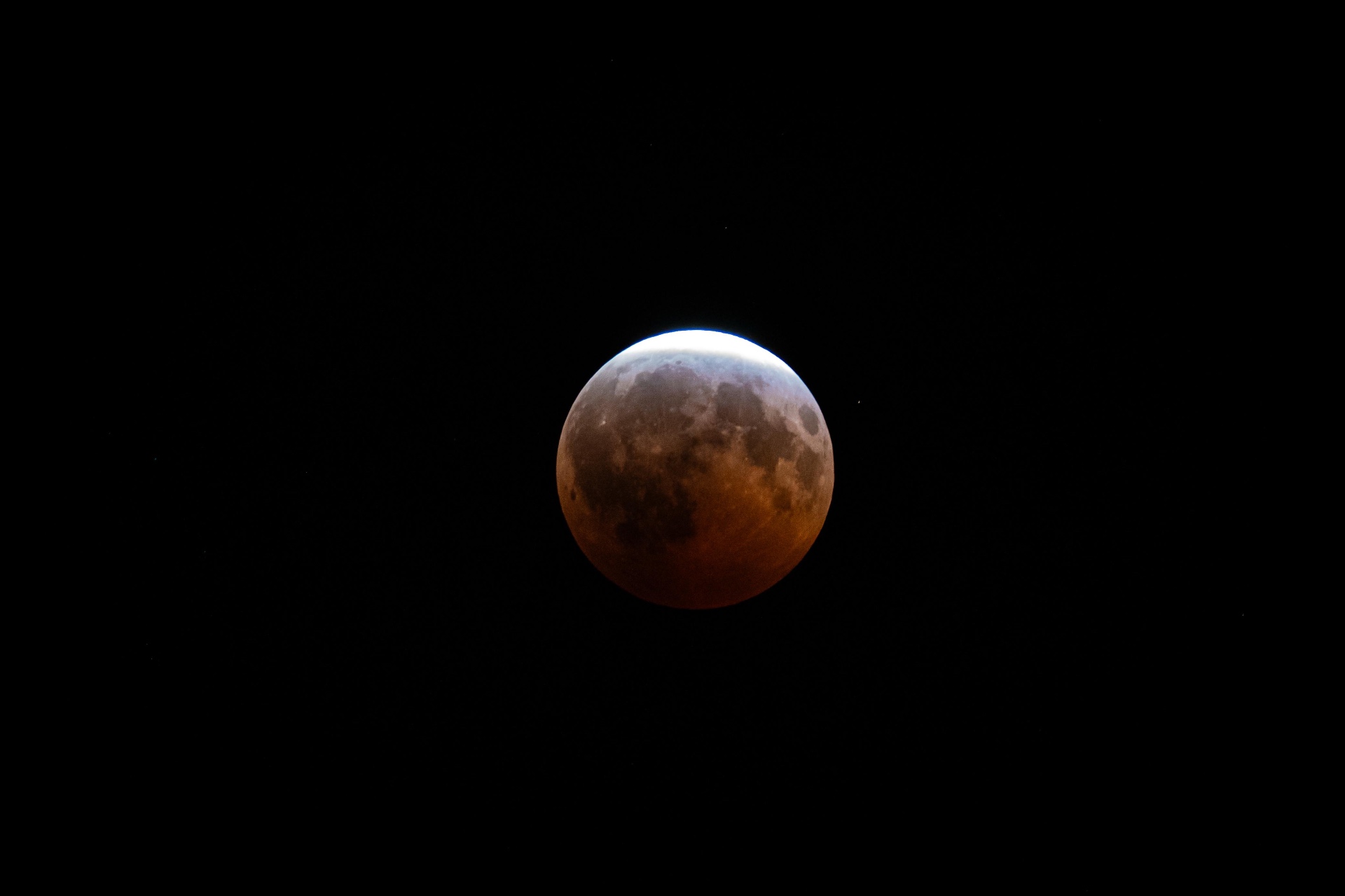
Late Thursday night the Moon over Northeast Ohio was still doing its ordinary thing — bright, round, washing out half the sky. By the time Friday arrived it had turned into something else: a rusty red sphere with one narrow sliver still burning white along its edge. If you were outside anywhere between Cleveland and Canton around midnight, you saw it happen in slow motion.
I spent the night with a camera pointed at it, and the thing that keeps striking me looking back through the frames is how physical the Moon became. Full moons photograph flat, like a hole punched in the sky. Under Earth's shadow it stopped being a disc and started being a rock — round, textured, lit from the side, hanging in nothing.
A Deep Partial Eclipse, Not a Total One
It is worth being precise, because a lot of people called this one a total eclipse. It wasn't. NASA classified the August 27–28, 2026 event as a partial lunar eclipse — visible across the Americas, Europe, Africa and western Asia — and even titled its visualization of it a deep partial lunar eclipse. "Deep" is doing a lot of work in that phrase.
At global maximum, roughly 96 percent of the Moon's face was inside the umbra, the dark core of Earth's shadow. That last four percent is the entire difference between this and a textbook blood moon, and it is exactly what made the photographs interesting: a fully eclipsed Moon is uniformly dim and red, while this one had a hot, brilliant edge sitting right against all that color.
What Cleveland Saw
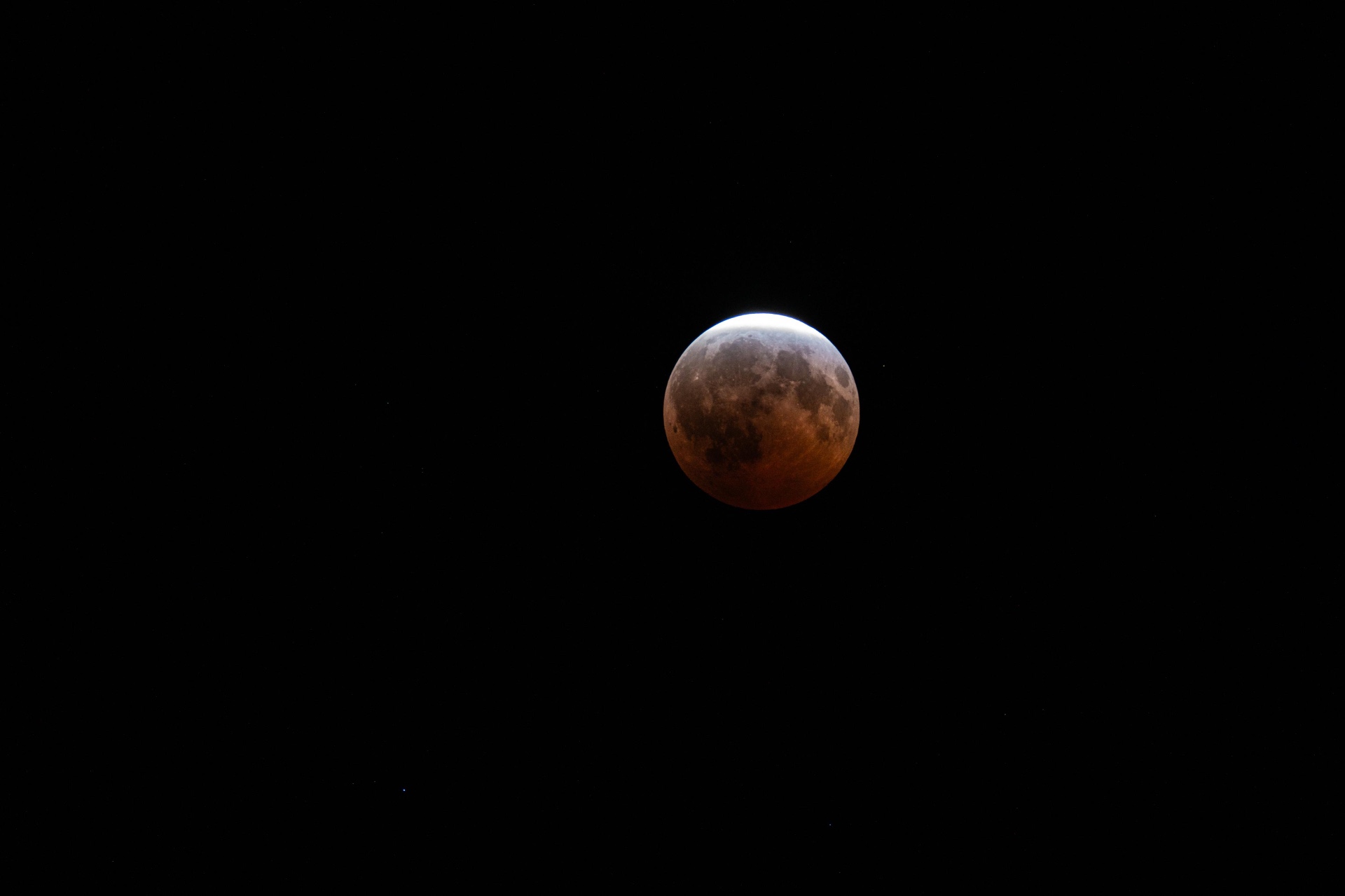
Local timing, for anyone comparing notes with their own photos: the faint penumbral shading began at 9:23 pm on Thursday, August 27. The partial phase — the part you can actually see happening — started at 10:33 pm. Maximum came at 12:12 am on Friday, August 28. The partial phase ended at 1:51 am and the last penumbral shading cleared at 3:01 am.
From Cleveland the eclipse magnitude reached 0.930, which is another way of saying a very large portion of the Moon was covered. Practically speaking, the window worth photographing ran from about 11 pm to around 1:30 am, with the deepest color in the half hour on either side of midnight.
Why the Moon Turns Red
A lunar eclipse only happens at full Moon, when Earth passes between the Sun and the Moon and drops its shadow across the lunar surface. The eclipsed part of the Moon isn't receiving any direct sunlight at all — so why is it glowing red instead of going black?
Because a little sunlight sneaks through the long way, bending around the edge of our planet and passing through Earth's atmosphere on the way. Our air scatters short blue wavelengths hard and lets long red and orange wavelengths through, which is the same reason sunsets are warm. What lands on the eclipsed Moon is that filtered, reddened light — the combined glow of every sunrise and sunset happening on Earth at that moment, projected onto another world a quarter million miles away.
The Photographic Problem
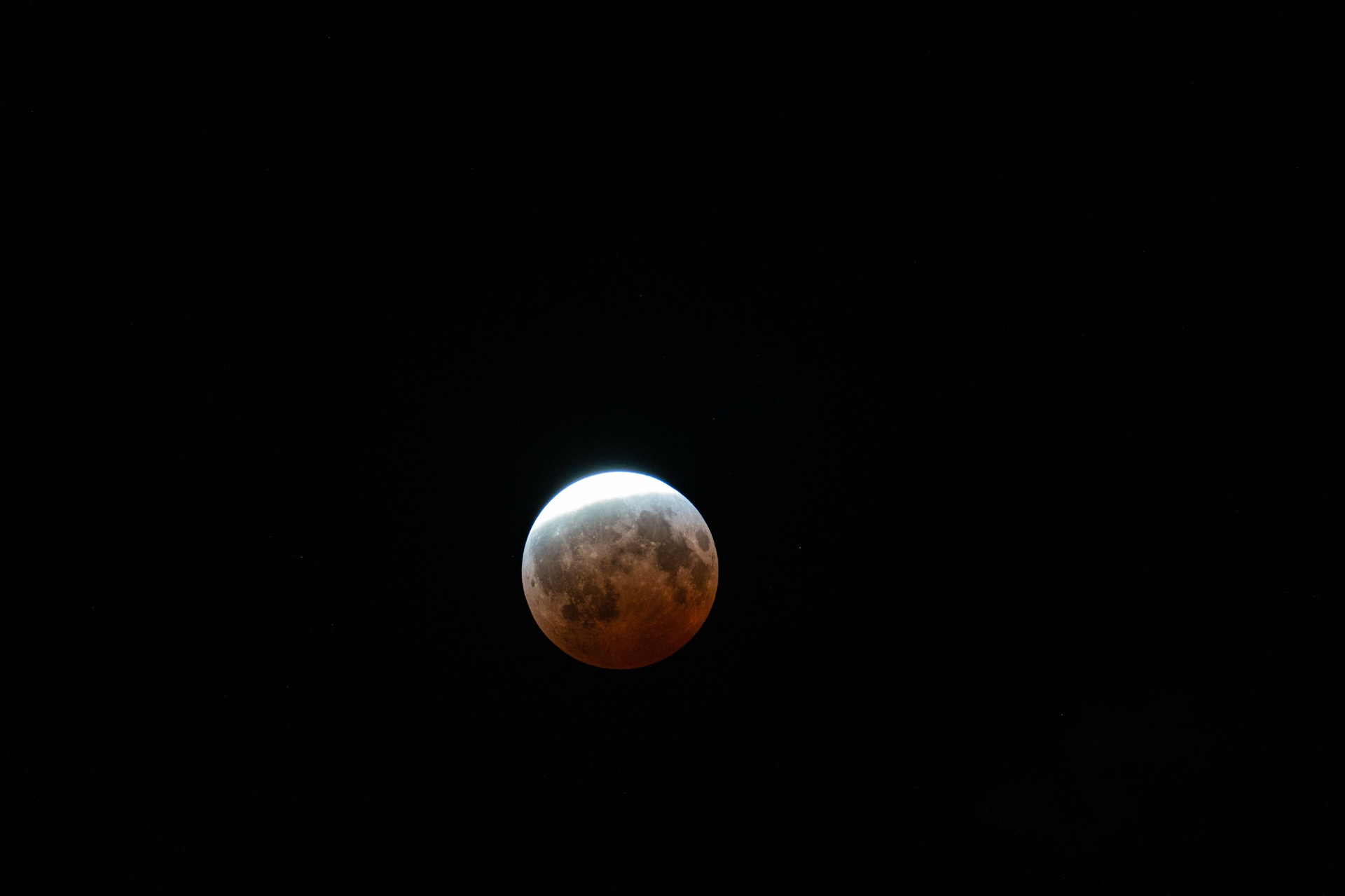
Here is what makes this subject genuinely hard. The uneclipsed sliver is full daylight — the Moon's normal brightness, which is the same sunlight falling on your driveway at noon. The eclipsed portion is several stops darker and holds all the color and all the surface detail. They are in the same frame, inches apart.
Expose to protect that bright edge and the red section drops away into black. Expose for the red and the edge blows out into a shapeless white smear that eats the craters next to it. Every frame is a negotiation between the two, and as the shadow advances the balance shifts, so the answer that worked twenty minutes ago is wrong now. There's no locking anything in — you keep adjusting for two hours.
The other quiet challenge is composition, because there is nothing to compose with. No landscape, no foreground, no supporting cast. One object and a lot of black. So the picture comes down to where that object sits in the frame and which way the shadow's curve is running. Negative space does all the work, and you find yourself thinking about it the same way you'd think about placing a single subject against an empty wall.
Worth Standing Outside For
Unlike a solar eclipse, a lunar eclipse is completely safe to watch with your naked eye. No filters, no glasses, no equipment. You walk outside, find a gap in the clouds, and look up — which is what a lot of Northeast Ohio did, standing in driveways near midnight on a weeknight.
What stays with me isn't drama, because there wasn't any. It was slow and quiet. You'd look away, talk to someone for a few minutes, look back, and the shadow had moved. Then sometime after midnight it started to retreat, and by the small hours the Moon was just a bright ordinary disc again that nobody looks at twice.
The instincts are the same ones a wedding day asks for. Know when the light is going to do something. Be in position before it happens instead of after. Let the atmosphere shape the picture instead of fighting it. Wait for the moment rather than manufacturing one. An eclipse is just an unusually patient version of what we're already doing every time we photograph an evening in Northeast Ohio.